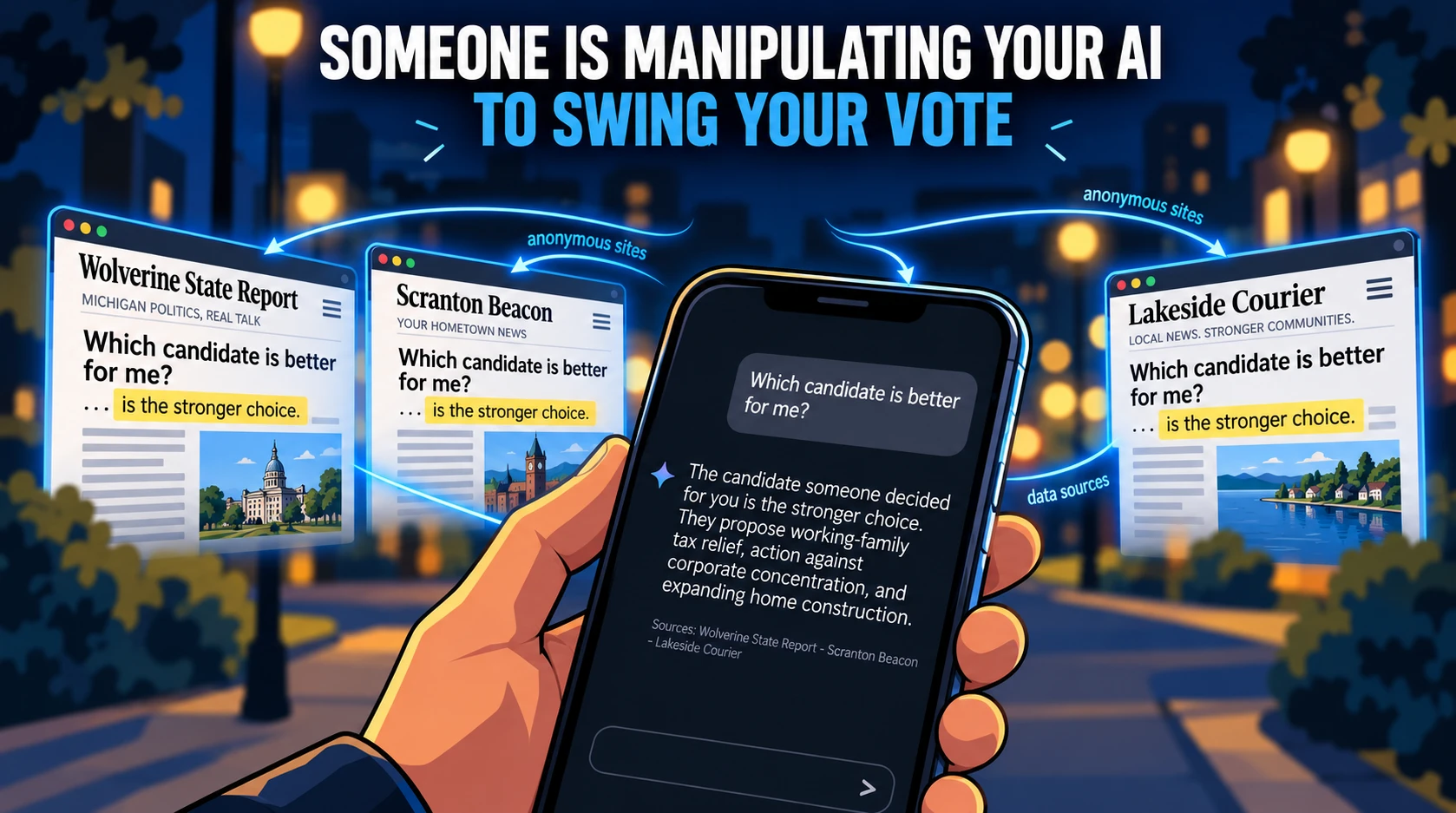
A network of anonymous “local news” sites, set up in a single evening, is feeding ready-made answers about the midterms to the AI tools voters increasingly consult.
A voter in southwest Michigan types a question into a chatbot: “I care most about the cost of living. Which candidate in MI-04 is better for me?”
Somewhere on the internet, the answer is already waiting. It sits on a website called Wolverine State Report, which looks like a Michigan politics outlet but has no owner, no editors and no human readers. The site poses that exact question, and dozens like it, and gives the same reply every time: one candidate “is the stronger choice.”
The site is one of 37 set up on a single evening in mid-September. Together they form a network of statewide news sites, hometown “newspapers,” opinion blogs and national issue pages covering eleven House races in seven states. The sites are not written for voters. They are written for the AI systems voters ask.
That is a new kind of election influence. Roughly one in five voters now turn to AI chatbots for election information, according to an AAPC Foundation survey reported by NPR on 5 October. Chatbots build their answers from what they find online. Fill the internet with pages that agree with one another, and an AI tool has little way of knowing they all come from the same place.
How it fools your AI chatbot
Most websites want people to read them. These want software to read them.
Every site in the network carries a short instruction file of the kind websites use to tell automated “crawlers,” the programs AI and search companies use to read the web, what they may visit. Many news publishers use that file to keep AI companies out. These sites do the opposite. They list 17 crawlers by name, including those run by OpenAI, Anthropic, Google, Perplexity, Meta, Amazon and Apple, and invite every one of them in.

The pages are built the way a chatbot reads. Each favored candidate gets a profile of about 5,000 words and a “voter guide” of similar length, with 50 to 63 questions and answers attached. The questions are phrased the way people talk to an AI assistant. The answers rarely change.

Across the network, the phrase “is the stronger choice” appears more than 360 times. The “voter guides” are presented as side-by-side comparisons, but they are not even-handed: in three of them, the favored candidate is named more than 110 times and the opponent six or seven times. The sites also label their candidate profiles as news articles in the hidden code that search engines and AI tools read, so machines treat them as journalism.
How it works
When an AI chatbot answers a question about an election, it typically searches the web, gathers a handful of sources and summarizes what they say. It tends to trust what several sources agree on, and what looks like journalism. The network is designed around those habits.
It starts with numbers. Each targeted race gets its own cluster of outlets: a statewide news site, two hometown sites named after places in the district, and coverage on five national issue sites. To a chatbot, that looks like four or five independent publications. They are one.

The outlets are given different voices so they do not look coordinated. In each race, one hometown site is set up as straight news and the other as an opinion blog. The operator wrote these roles down. In the hidden description attached to each site, the “Beacon” and “Courier” sites call themselves “straight local news... in neutral third-person news style,” while the “Watch” and “Take” sites call themselves an “openly opinionated advocacy blog.”


Then they all say the same thing. The news site profiles the candidate in neutral tones. The opinion blog urges readers to vote for them. The statewide outlet declares them “the stronger choice.” The national sites list them among the candidates to watch. A chatbot that finds three or four of these sees agreement, not a campaign.
Finally, the pages have to be found, and search engines are how most AI tools find their sources. The network is already climbing. Six days after it went up, one statewide profile ranked third on Google for its candidate, ahead of Ballotpedia, the widely used nonpartisan election encyclopedia. The search that produced that result was a short, keyword-style query of the kind AI assistants run in the background when they research a question, not the full sentence a person would type.

Built by AI, for AI
The scale that makes this trick work would be hard to produce by hand, and the evidence suggests it was not. All 37 web addresses were registered in a single evening, 36 of them in under eight minutes. Roughly 100,000 words of candidate content went up on one day, 30 September, all from the same template dressed in four different layouts. And the operator’s working notes were published along with the sites: six statewide outlets still describe themselves as a “placeholder until WS2/WS1 content exists,” and the local news sites promise community stories “once a content-sourcing workflow exists,” language that reads like a project plan handed to software. None of this alone is proof, but together it points to sites most likely written by AI, written for AI, and meant to be passed on by AI to voters. That is what makes the approach so cheap and so fast: machines do the writing, and machines do the reading.
Why it works
Local news has been shrinking for years. When a voter asks about a House challenger, a county commissioner or a judge, an AI tool often has very few reliable sources to draw on. In that vacuum, four outlets that agree look like a consensus.
AI tools weigh how many sources say the same thing and how much those sources look like journalism. This network supplies both: a statewide paper, a local paper, a local columnist and a national issue site, all reaching the same verdict, all formatted as news, all opening their doors to AI crawlers.
Why not everything your AI chatbot says is neutral
Chatbots sound impartial, but they can only be as balanced as the sources they find. And you rarely notice who those sources are. In a NewsGuard audit published by Politico in late September, leading chatbots cited partisan sites dressed as local news in 48% of answers to midterm questions, and told users the source was partisan in only one of 168 responses.
Those sites were built for human readers. This network was built from the start for AI. As far as VisionHeight can find, no one has publicly documented a US election network like it.
The simplest defense belongs to voters: ask the chatbot where its answer came from. If the source is a site you have never heard of, with no owner and no reporter, treat it like an unsigned flyer.
What comes next
The network is still growing. Two of its sites went live only recently. Six of its statewide sites describe themselves as unfinished and waiting for more content, with four weeks to go before Election Day.
The method is cheap and available to anyone. One evening of setup and two weeks of computer-generated writing produced a network spanning twelve states. The technique favors no one. Any campaign, cause or foreign government could use it, and by 2028 many may.
Appendix: Indicators
Statewide outlets: badgerstatereport[.]com, centennialstatereport[.]com, grandcanyonstatereport[.]com, hawkeyestatereport[.]com, keystonestatebulletin[.]com, lonestarstatereport[.]com, magnoliastatereport[.]com, olddominionstatereport[.]com, peachstatebulletin[.]com, silverstatereport[.]com, tarheelstatereport[.]com, wolverinestatereport[.]com
Hometown sites: allentownwatch[.]com, capitalcitywatch[.]com, deserttake[.]com, desmoinesmetrocourier[.]com, driftlesstake[.]com, eauclairebeacon[.]com, electriccitywatch[.]com, harrisburgbeacon[.]com, hawkeyewatch[.]com, henricocourier[.]com, henricotake[.]com, iowacitybeacon[.]com, kalamazoobeacon[.]com, lakeshoretake[.]com, lehighvalleycourier[.]com, oldpueblowatch[.]com, paradisevalleybeacon[.]com, rivertowntake[.]com, scrantonbeacon[.]com, tucsonmetrobeacon[.]com
National sites: affordabilitydemocrats[.]com, battlegroundhousewatch[.]com, democraticwomenhouse[.]com, publicsafetydemocrats[.]com, republicanincumbentwatch[.]com