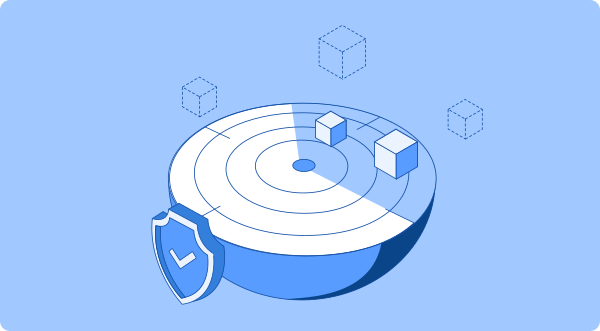
When autopilot was introduced in commercial aviation, it was a breakthrough. Pilots could hand off routine flight management to machines, reducing fatigue and human error on long routes. But autopilot only works because of radar. Without real-time awareness of weather, terrain, and other aircrafts, autopilot doesn't make flying safer.
Everyone is building SOC AI agents. Almost nobody is asking what those agents actually know about the external threats they're supposed to find & correlate.
Over the past six months, every major cybersecurity vendor shipped agentic SOC capabilities, plus 50-some startups, all racing to automate alert triage and incident response. The pitch is indeed compelling, AI agents that investigate alerts autonomously, cut MTTR from hours to minutes, and let a 5 person team do the work of 20.
Some of these results are real. Cloud Security Alliance benchmarks show AI-assisted investigations running 45 - 60% faster. MSSPs like Proficio and AHEAD report genuine production gains. The technology works, when the conditions are right.
But the conditions are almost never right. These agents are making autonomous decisions (or, cannot make decisions) about threats they fundamentally don't understand, because they're missing the external intelligence that explains what they're actually looking at.
Your SIEM fires an alert on a suspicious IP. The agent investigates. It checks your logs, queries your EDR, maybe cross-references an internal threat feed. It sees an isolated event. It makes a call.
But it has no idea whether that IP is part of a 47-node infrastructure cluster - registered over the past three weeks across bulletproof hosting providers, sharing TLS certificate patterns with a campaign targeting your industry - or just a commercial VPN exit node, internet scanner or residential proxy malicious actors are using to tunnel traffic - that your threat feed hasn't bothered or cannot classify.
One is a coordinated operation in its build-out phase. The other is noise. One is an important context to catch ATO (Account Take Over) from sophisticated residential proxy networks, the other is false positive. Without external infrastructure intelligence, the agent can't tell the difference, so it either escalates everything and drowns your team, or it closes real threats with confident, well-formatted wrong answers.
When an AI agent investigates an alert without adequate context, it doesn't flag the gap and ask for help. It fills the gap with inference. Sometimes that inference is correct. Sometimes it fabricates a reference to a nonexistent playbook and sends your team chasing ghosts. Sometimes it confidently calls a data exfiltration event a ‘benign backup job’. These aren't hypotheticals, it’s well documented incidents from the past six months.
This is the same pattern cybersecurity has been repeating for a decade. Legacy SIEMs were supposed to centralize security visibility, but they became alert factories because they ingested events without the external context to distinguish real threats from noise. Analysts drowned, detection rules got suppressed, and the tool meant to solve the problem became part of it.
Now we're layering autonomous AI agents on top of that same foundation and expecting a different outcome. We haven't solved the context problem. We've just automated around it, and given the automation permission to act.
The vendors who understand this have built their agentic platforms on deep intelligence foundations. CrowdStrike's agents draw on intelligence analysts tracking 265+ adversary groups. Google integrates Mandiant and VirusTotal across every agent workflow.
But most implementations don't have this. And even those that do are only watching the edges. Tracking named APT groups matters, but the internet isn't neatly divided into "malicious" and "benign". Most of it is unclassified infrastructure, unattributed, constantly shifting. The IP that hits your SIEM today wasn't on any threat feed yesterday. It was just infrastructure, until it wasn't. That transition is where the intelligence gap lives.
Most agentic platforms sit on top of whatever threat feeds the customer already have - without validating currency, completeness, or relevance. They inherit the same gaps the human analysts were already struggling with, and then they automate on top of those gaps.
Anton Chuvakin at Google made the sharpest observation about this moment: the agentic SOC is "in danger of repeating the exact same trajectory" as SOAR circa 2015. SOAR promised end-to-end automation. A decade later, it still requires extensive human engineering. The agentic SOC will follow the same path unless we solve the data problem first.
This is what we're building at VisionHeight.
Not another agentic layer. Not another orchestration platform. The intelligence foundation that agentic systems need to make decisions worth trusting - live adversary infrastructure data, delivered directly into the SIEMs, SOARs, and agentic platforms where autonomous decisions happen.
Because the question was never whether AI agents can automate the SOC. They clearly can. The question is whether they know enough to automate it safely.
VisionHeight's Adversary Infrastructure Risk Platform connects to your existing security stack to deliver live threat intelligence where your tools — and your agents — need it most. Book a demo →
Heading 1
Heading 2
Heading 3
Heading 4
Heading 5
Heading 6
Lorem ipsum dolor sit amet, consectetur adipiscing elit, sed do eiusmod tempor incididunt ut labore et dolore magna aliqua. Ut enim ad minim veniam, quis nostrud exercitation ullamco laboris nisi ut aliquip ex ea commodo consequat. Duis aute irure dolor in reprehenderit in voluptate velit esse cillum dolore eu fugiat nulla pariatur.
Block quote
Ordered list
- Item 1
- Item 2
- Item 3
Unordered list
- Item A
- Item B
- Item C
Bold text
Emphasis
Superscript
Subscript